
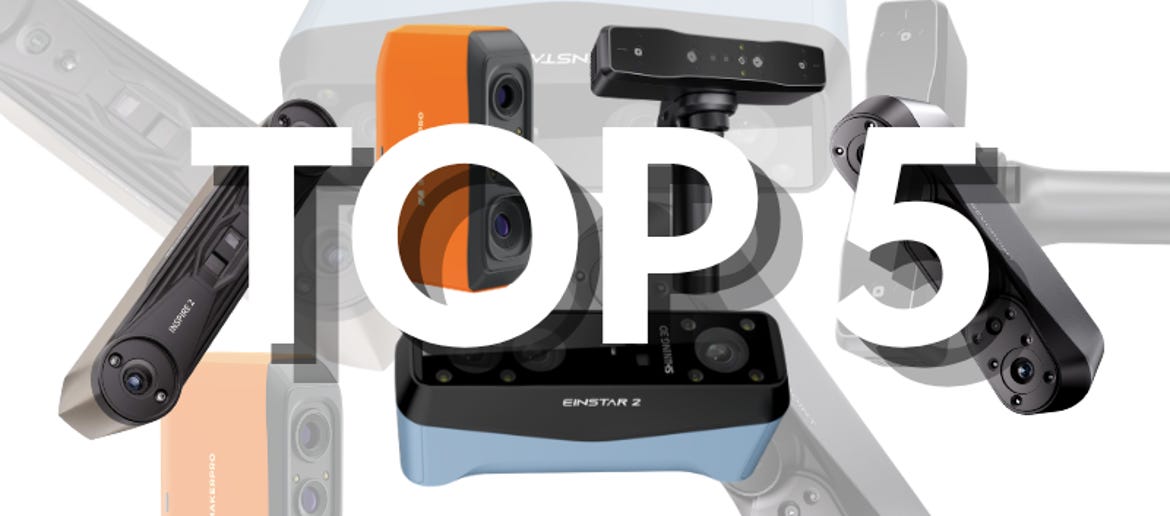
5 Affordable 3D Scanners for Beginners
As of June 2026
You've mastered your 3D printer, and now you're wondering where to get your next models? The answer is simple - a 3D scanner. With a 3D scanner, real-life objects can be transformed into digital models, whether it's a broken spare part, a favourite figure or your own face. Best of all, professional 3D scanning is no longer the reserve of professionals in 2026, and has well and truly arrived in the hobbyist's workshop, too. Technologies such as infrared lasers, AI tracking and marker-free scanning, which cost four-figure sums only a few years ago, are now available at much more accessible prices, starting from around €200-300.
In this article, we'll take a closer look at five particularly popular models, all of which are excellent choices for beginners. We'll take a look at their technical capabilities, how they differ in price and which projects they are best suited to. Our aim is to make your decision easier and help you get into the world of 3D scanning with as little stress as possible.
We'll be looking at the following models:
- 3DMakerpro Fox as the budget-friendly choice for your first scan,
- Revopoint INSPIRE 2 as the technology hero for difficult surfaces,
- Creality Otter Lite as the precision all-rounder,
- Revopoint POP 4 as the newcomer with blue laser & 3D Gaussian Splatting,
- Shining 3D Einstar 2 as the wireless premium pick.
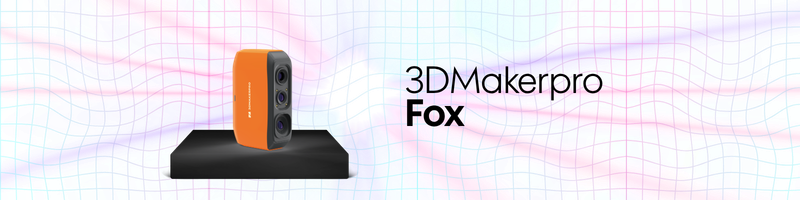
What would have sounded like a toy not long ago has become reality with the 3DMakerpro Fox since spring 2026, and with specifications that make some scanners twice its price look outdated. This new arrival in bright orange offers an accuracy of 0.07 mm, proving that getting started with 3D scanning no longer has to blow a hole in your budget.
► Your benefits:
The Fox 3D scanner is designed from the ground up for an easy start. Simply connect the scanner, open the JMStudio software and you're good to go in under 10 minutes, with no lengthy marathon session for calibration. During the scanning process, the software displays a live 3D preview with distance and tracking indicators, so you can see straight away whether everything is on track. First scan? The guided setup assistant takes you through the process step by step.
One true highlight is the AI-supported visual tracking. If you move too quickly or lose your position while scanning, the Fox recognises your object again within seconds and continues the scan seamlessly, without restarting and without frustration. Exactly the kind of fault tolerance beginners need.
Technically, this compact scanner also has plenty to offer. With an accuracy of 0.07 mm and a resolution of 0.10 mm, it reliably captures fine edges, structures and surfaces. Thanks to modern NIR technology, it works without markers even on dark and matte materials, without the need for scanning spray. At just 210 g, it is lighter than most smartphones and captures objects from 40 mm up to an impressive 1.2 m, from gaming figures to machine parts.
Good to know: The Fox captures geometry, but not colour textures. For 3D printing, reverse engineering and modelling, that is completely fine. However, anyone wanting colour scans of figures or faces should consider the other scanners below.
Conclusion: The 3DMakerpro Fox is the perfect scanner for finding out whether 3D scanning is for you, while delivering results that go far beyond simple experimentation. In 2026, you will not find a better scanner in this price range.

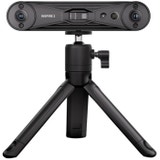
Dark surfaces, shiny metal, bright sunlight: these are exactly the situations where affordable 3D scanners have traditionally struggled. The Revopoint INSPIRE 2 changes that. As the only scanner in its price class, it combines 11 parallel infrared laser lines with infrared structured light, a technology that, until recently, was only found in professional devices.
► Your benefits:
The dual-mode system is the heart of the INSPIRE 2. Laser mode captures dark, glossy and complex surfaces cleanly and reliably, even without scanning spray. Structured light mode, on the other hand, is ideal for body, face and detailed object scans. In other words, you get two scanners in, and suitable for practically any material. The INSPIRE 2 also performs strongly when it comes to precision. With an accuracy of up to 0.05 mm and precision of up to 0.03 mm, it delivers crisp models that are also suitable for reverse engineering and fit-critical projects. The optical zoom levels, 1.5x and 2x, help capture all details, even on mixed geometries.
Particularly practical for makers with outdoor ambitions: the INSPIRE 2 works reliably even at up to 20,000 lux, so scanning outdoors or by a bright workshop window is no problem. Its aerospace-grade aluminium front can also handle the odd knock. Connection options are flexible too. Scan on the move with a smartphone via WiFi or USB-C, or use Revo Mirror to scan on your PC and stream the result live to your phone. The integrated RGB camera provides realistic colour textures for lifelike models.
Conclusion: The Revopoint INSPIRE 2 is the technology hero in our list. No other scanner under €700 handles difficult surfaces with such confidence. Anyone who wants to scan without material limitations from the very start will find the best overall package of the 2026 generation here.
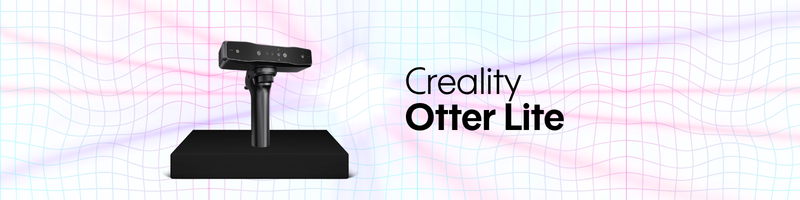
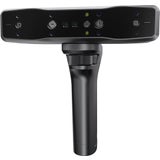
Do you want to avoid being tied to a specific object size when scanning? The Creality Otter Lite brings the clever four-lens system of the popular Otter series into a price range that is accessible for ambitious beginners, while delivering results with up to 0.05 mm accuracy that moves towards professional territory.
► Your benefits:
At the heart of the Otter Lite are its two dual-lens pairs. The long-focal pair captures small objects with maximum detail, while the short-focal pair efficiently records large surfaces. So you won't need to change devices when your project changes. The scanner adapts to the task.
With an accuracy of up to 0.05 mm, you can create scans suitable for demanding applications such as reverse engineering or precisely fitting spare parts. At the same time, 24-bit full-colour scanning ensures that textures and colours are realistically preserved. This combination of precision and colour makes the Otter Lite the most versatile device in our list.
As with its bigger brother, Creality Scan software guides you through the entire process with step-by-step instructions and one-click model creation, from the first scan to a print-ready model, without getting lost in settings menus.
Conclusion: The Creality Otter Lite is the precision all-rounder for anyone who wants to scan small objects today and larger ones tomorrow, without compromising on accuracy or colour. The best “one scanner for everything” package under €1,000.

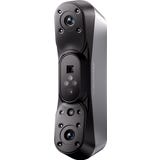
What if a scanner could capture not only the shape of an object, but its entire photorealistic appearance? The Revopoint POP 4 is the most exciting scanner newcomer of 2026: a hybrid of blue laser and near-infrared technology, and the first in its class to support 3D Gaussian Splatting, producing scans that look like photos you can almost touch.
► Your benefits:
At the heart of the POP 4 is its hybrid light system. The blue laser captures the finest details and handles exactly the surfaces where conventional scanners struggle: glossy black plastic, polished metal and dark fabrics, all without scanning spray. The near-infrared mode, VCSEL, takes care of large objects and people from distances of up to 800 mm. A total of five scan modes cover everything from deep holes using single-line scanning to fast large-area scanning.
Things become truly future-facing with 3D Gaussian Splatting. The POP 4 turns your scan data into photorealistic 1:1 models that can be exported in SPLAT format, perfect for VR/AR projects, digital twins or immersive presentations. Until now, this technology simply did not exist in a scanner in this price class.
The POP 4 also thinks practically. AI object segmentation detects your target object before the scan and automatically hides the surrounding area. This eliminates the tedious task of cutting away tables and backgrounds afterwards. Thanks to the included 5500 mAh battery grip, you can scan wirelessly for around 4 hours, conveniently controlled via smartphone or tablet. With suitability up to 100,000 lux, equivalent to direct midday sunlight, even façades, vehicles or monuments outdoors are no problem.
Despite all this, precision remains at a professional level. In laser modes, the POP 4 achieves volumetric accuracy of 0.03 mm + 0.05 mm/m at up to 105 fps and is fully integrated into the Revopoint ecosystem, from scanning and Revo Measure through to reverse engineering in Revo Design.
Conclusion: The Revopoint POP 4 offers a glimpse into the future of 3D scanning: blue laser precision, AI convenience and photorealistic Gaussian Splatting models in one wireless device. Anyone who wants to get started in 2026 and wants to be ahead of the curve should have this device on their shortlist.

No more cable clutter. The Shining3D EINSTAR 2 is the only scanner in our list that works completely wirelessly: insert the replaceable battery, head out and scan for up to 3 hours at a time, wherever you like. The successor to the popular Einstar brings real professional freedom into the maker space and is our premium pick for anyone who wants to start without compromise from day one.
► Your benefits:
Wireless freedom is more than just convenience. Without being tied to a socket, you can scan motorbikes in the garage, sculptures in the garden or full people in the living room. At just 420 g, the EINSTAR 2 also remains comfortable to hold even during longer sessions.
Technically, the EINSTAR 2 takes a dual approach. Its hybrid light source combines 17 parallel laser lines for small, detailed objects with IR VCSEL technology for large models and full-body scans at up to 20 fps. It captures an entire person in just 60 seconds, including vibrant colours thanks to the integrated RGB camera. Best of all, even black or reflective materials are captured cleanly, without mattifying spray.
It also performs strongly outdoors. In IR Rapid mode, the scanner remains stable even at 70,000 lux. Bright sunlight, changing lighting or a dim workshop: the EINSTAR 2 delivers reliably. The new EXStar Hub software guides you through the entire workflow with a unified interface.
It should be said honestly, though: the data volumes produced by the EINSTAR 2 need processing. Shining3D recommends a powerful PC with a modern NVIDIA graphics card and plenty of RAM. Anyone who only has an office laptop should factor this in before buying.
Conclusion: The Shining3D EINSTAR 2 is the scanner for anyone who wants to start properly: wireless, fast, material-independent and with professional DNA. If you regularly scan large objects or people and have the right computer, this is by far the most flexible scanning experience in this list.
What about the price?
For a long time, the rule of thumb for 3D scanner prices was simple: if you wanted quality, you paid four figures. Those days are over, because in 2026, there is a scanner for every budget that delivers real, print-ready results. Here, we show you how our five favourites compare in terms of price. We use regular prices as a guide, as of June 2026, but many of these models are regularly available at significantly lower prices during promotions. It is therefore well worth checking the relevant product page.
► Affordable 3D scanners up to €300 – the risk-free entry point
⇒ The 3DMakerpro Fox is by far the most affordable route to serious scanning results. 0.07 mm accuracy, AI tracking and marker-free scanning at this price simply did not exist before 2026. The perfect choice for dipping a toe into the hobby without eating into the budget for your next printer.
► Beginner-friendly 3D scanners up to €700 – technology without material limits
⇒ The Revopoint INSPIRE 2 brings professional technology into the entry-level class with its dual mode of laser lines and structured light, including outdoor suitability up to 20,000 lux. Anyone who regularly wants to scan dark or glossy objects will be in exactly the right place here.
► Beginner-friendly premium 3D scanners under €1,000 – professional-level precision
⇒ The Creality Otter Lite is the only scanner in its class to combine a four-lens system with 0.05 mm accuracy and 24-bit full-colour scans. Anyone who wants to capture everything from a coin to a piece of furniture with a single device gets the most well-rounded overall package under the €1,000 mark.
⇒ The Revopoint POP 4 is the scanner newcomer of the year: blue laser hybrid technology, AI object segmentation, around 4 hours of battery operation and, as the first in its class, photorealistic 3D Gaussian Splatting. Anyone thinking in terms of VR/AR, digital twins or demanding reverse engineering gets the most advanced technology in the list here.
⇒ The Shining3D EINSTAR 2 is deliberately priced above the rest of this list, but it offers something special in return: completely wireless scanning with a replaceable battery, full-body scans in 60 seconds and outdoor stability up to 70,000 lux. Anyone who does not just want to try scanning, but wants to make it a permanent part of their workflow, can invest properly once and avoid upgrading later.
In short: for trying things out, there is no getting around the 3DMakerpro Fox. You will not find a better scanner for the money. The Revopoint INSPIRE 2 is the best choice when difficult surfaces are on the agenda, while the Creality Otter Lite is the most versatile all-rounder under €1,000. In the premium class, 2026 gives you a choice between two approaches: the Revopoint POP 4 with blue laser and photorealistic Gaussian Splatting, or the Shining3D EINSTAR 2 for wireless full-body and large-object scans.
Our conclusion: scanning is becoming the new print workflow
If this comparison shows one thing, it is this: in 2026, 3D scanning is no longer a professional-only discipline, but the logical extension of every maker setup. What used to require measuring equipment costing thousands of euros can now be handled by a 200-gram device that uses AI to take care of tracking, and getting started costs less than some filament orders.
Which scanner is right for you mainly depends on what you want to digitise. Do you simply want to try 3D scanning without much risk and see whether it is for you? Then the 3DMakerpro Fox is the best option for you. If you're planning to tackle challenging surfaces, such as dark parts, shiny metal or outdoor projects? Then there is no getting around the Revopoint INSPIRE 2. Looking for the most versatile all-rounder, one that captures everything from a coin to a piece of furniture accurately and in colour? Choose the Creality Otter Lite. Want future-facing technology such as blue laser precision and photorealistic 3D Gaussian Splatting? The Revopoint POP 4 is your device. And anyone who wants wireless professional freedom for full-body scans and large objects from day one should make a proper investment in the Shining3D EINSTAR 2.
Whichever you choose, each of these five devices turns your real world into print-ready 3D models and gives your 3D printer access to an endless library of models: your surroundings. Broken gear? Scan, repair, print. Enlarge a favourite figure? Scan, scale, print. And so on. The question is no longer whether a 3D scanner is worth it, but what you will digitise first.
Still unsure or have questions about one of the models? Our support team will be happy to help. And if you still need the right printer for your scans, take a look at our guide to the best affordable 3D printers for beginners.
Technical specifications: A comparison. What's under the hood?
Accuracy, resolution, capture range: with 3D scanners, the technical specifications have an even more direct impact on the result than they do with printers. We've listed the most important values of the five models side by side so you can see at a glance which scanner is best suited for your projects.
| 3DMakerpro Fox | Revopoint INSPIRE 2 | Creality Otter Lite | Revopoint POP 4 | Shining 3D Einstar 2 | |
| Light source | NIR structured light | 11 parallel infrared laser lines + infrared structured light | structured infrared light, binocular | 30 blue crossed laser lines 1 blue single laser line Near-infrared full-field structured light Near-infrared VCSEL structured light |
17 parallel blue laser lines IR VCSEL |
| Accuracy | 0.07 mm | up to 0.05 mm | up to 0.05 mm | 0.03 mm + 0.05 mm × L (m) | |
| Resolution | 0.10 mm | 0.1-2 mm | Laser: 0.05-10 mm IR: 0.2-10 mm |
||
| Colour scan | Mono textures | yes | yes | yes | yes |
| Object size | small to large | small to medium-sized | small to large | small to medium-sized | small to large |
| Outdoor suitable | no | yes | yes | yes | yes |
| Weight | 210 g | 190 g | 300 g | 286 g | 420 g |
| Dimensions | 115 x 70 x 35 mm | 53 x 27 x 132 mm | 173 x 39 x 56 mm | 160 x 30 x 72 mm | 130 x 37 x 61 mm |
FAQs: Frequently asked questions about 3D scanners for beginners
Which is the best 3D scanner for beginners in 2026?
For most beginners, the 3DMakerpro Fox is probably the best starting point. It is affordable, ready to use in under 10 minutes, and, thanks to AI tracking, forgives typical beginner mistakes. For difficult surfaces, the Revopoint INSPIRE 2 is the best choice. For photorealistic colour scans, the Revopoint POP 4 is ideal, while the Shining3D EINSTAR 2 is the best option for wireless scanning without being tied to a PC.
How much does a good 3D scanner for beginners cost?
In 2026, you can get good beginner-friendly 3D scanners for under €300. Devices with laser technology for difficult surfaces are typically between €500 and €700, while precision all-rounders such as the Creality Otter Lite are just over €800. Wireless premium models such as the Shining3D EINSTAR 2 cost around €1,400. But thanks to regular promotions and special deals, many models can be snapped up at significantly lower prices during a sale.
Do I need a PC for 3D scanning?
Not always. Some models can be connected to and controlled directly with a smartphone. However, a PC is recommended for post-processing large scans, such as mesh cleaning and repair. Powerful scanners in particular require a suitably capable computer for data processing.
Can I 3D print scanned objects directly?
Yes, scanners export in common formats such as STL or OBJ, which can be read by any slicer. The included software largely handles steps such as closing holes and optimising the mesh automatically, so the models are usually ready to print.
Do I need scanning spray or markers?
Increasingly rarely. Thanks to NIR and laser technology, modern entry-level scanners can also capture dark and matte surfaces without markers and without spray. Only highly reflective or transparent objects, such as glass or chrome, still benefit from mattifying scanning spray.
How accurate does a 3D scanner need to be for 3D printing?
For most maker projects, such as decorations, figures and simple spare parts, an accuracy of 0.1 mm is just fine. For precisely fitting functional parts and reverse engineering, 0.05 mm or better is recommended.
-
Budget Scanner im Jahr 2024
Related products
-
3DMakerpro Fox
- Scanner for medium-sized objects
- Accuracy: 0.07 mm
- Resolution: 0.10 mm
-
Revopoint Inspire 2, Premium Edition
- Small to medium-sized objects
- 11 parallel IR laser lines
- Infrared structured light
-
Revopoint Pop 4, Premium Edition
- Hybrid system combining a blue laser and infrared structured light
- Accuracy of up to 0.03 mm
- Scan rate of up to 5 million points per second
-
Creality Otter Lite
- Accuracy: up to 0.05 mm
- Two pairs of double lenses
- 24-bit full colour scan
Magazine Articles:
Discover 3DJake:
-
Ireland: Free standard delivery from € 87,90
-
Free
returns More than 11.300 products
We deliver worldwide to
more than 40 countries
